Mudroom & Entryway Organization for Boots, Coats & Ranch Dust
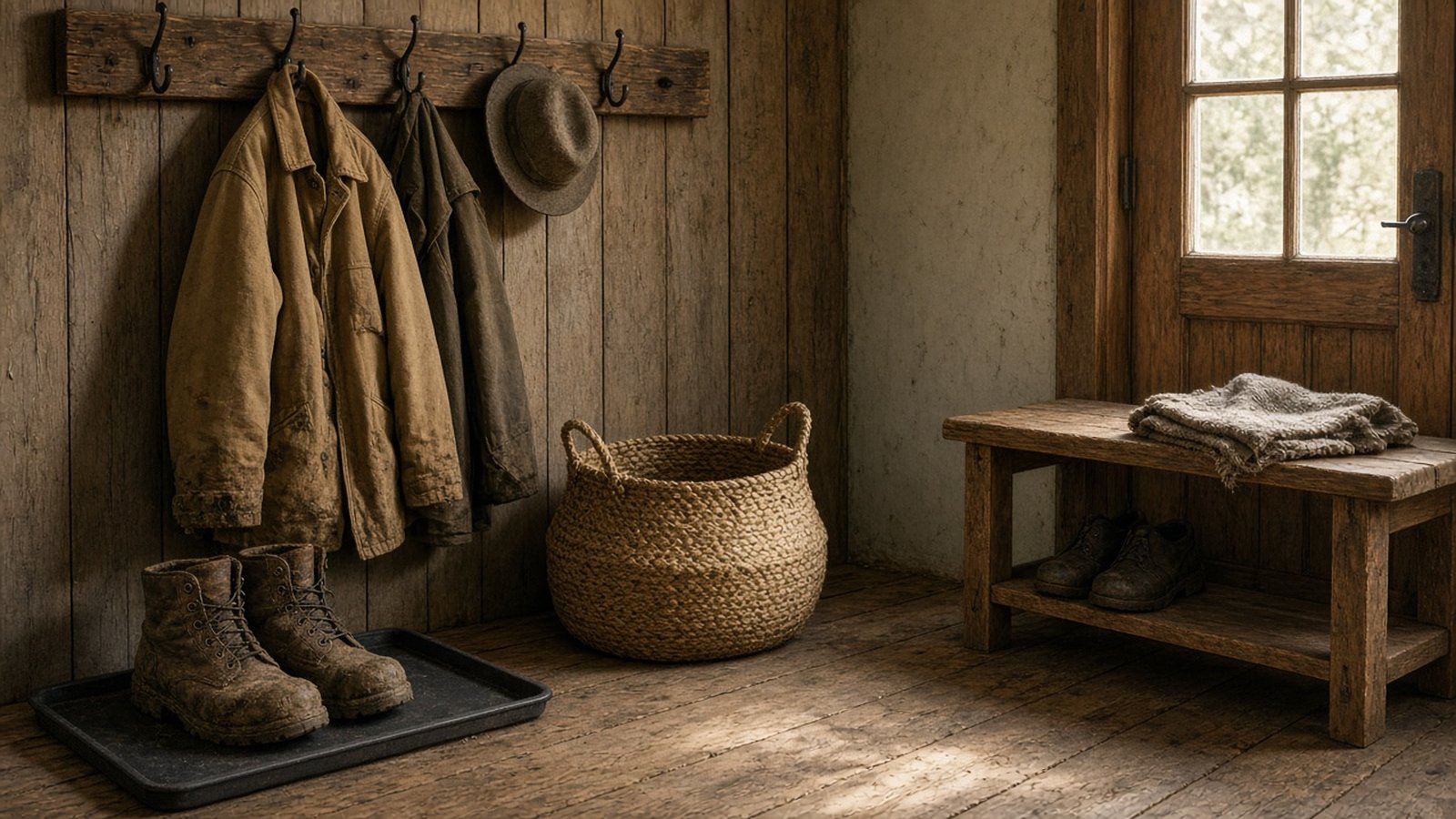
Featured Gear in This Guide
A short list for this chore. No prices, because those change. The button is a paid link.
-
Check on Amazon (paid link)
Ottomanson Heavy Duty Rubber Boot Tray, 16 x 32
Ottomanson
Best for Catching mud and snowmelt
-
Check on Amazon (paid link)
HBCY Creations Rustic Wall Mounted Coat Rack with Shelf, 24 Inch
HBCY Creations
Best for Heavy coats and hats
-
Check on Amazon (paid link)
VASAGLE 3-Tier Shoe Rack Storage Bench with Mesh Shelves
VASAGLE
Best for Seating plus shoe storage
-
Check on Amazon (paid link)
KOUBOO Large Round Seagrass Storage Basket
KOUBOO
Best for Gloves, hats, and blankets
-
Check on Amazon (paid link)
ROMA Cast Iron Beetle Boot Jack
ROMA
Best for Hands-free boot removal
If you live on land, the back door is the hardest-working spot in the house. It is where muddy boots come off after feeding, where wet coats get hung after a cold rain, and where the dog shakes off whatever pasture it just rolled in. Without a system, that mess tracks straight into the kitchen. With one, the dirt stays at the door and the rest of the house stays clean.
The good news is that a functional mudroom does not require a renovation. A small entryway, a laundry room wall, or even a corner by the back door can become a drop zone with five well-chosen pieces.
Plan the drop zone in three layers
Think about the entry from the floor up:
- Floor: Where wet and muddy things land. This needs to be waterproof and easy to hose off.
- Sitting height: Where you sit to pull off boots, and where shoes are stored out of the walkway.
- Wall: Where coats, hats, leads, and bags hang so nothing ends up on the floor.
If each layer has a home, the room more or less maintains itself.
The 5-piece mudroom setup
1. The floor saver: Ottomanson Heavy Duty Rubber Boot Tray
A boot tray is the first thing to buy. Raised edges hold snowmelt and mud so it does not seep across the floor, and a ridged surface lets boots drain and air out. Solid rubber stays flat, does not crack in the cold the way thin plastic trays do, and can be dumped outside and hosed off in seconds. The 16-by-32-inch size holds three or four pairs of work boots.
Why we like it: All-weather rubber that can live on a porch or inside the door year-round. Trade-offs: New rubber has a smell for the first week or two. Let it air out on the porch first.
Check current price on Amazon (paid link)
2. The wall anchor: HBCY Creations Rustic Coat Rack with Shelf
Wet canvas chore coats are heavy. A flimsy rack with tiny hooks will pull out of drywall the first winter. Look for a rack in solid wood that screws into studs, with deep hooks that will hold a coat, a hat, and a lead rope on the same peg. A built-in shelf on top is perfect for gloves, a flashlight, and the mail. This one is solid pine with five rustic metal hooks spaced generously apart, so bulky coats do not pile on top of each other, and it comes in several finishes from weathered brown to whitewashed.
Why we like it: It handles real winter coats and adds storage up top without taking floor space. Trade-offs: Locate studs before you mount it. Hollow-wall anchors alone are not enough for a fully loaded rack.
Check current price on Amazon (paid link)
3. The sit-down spot: VASAGLE 3-Tier Shoe Bench
Pulling off tall boots while standing on one foot is how people end up leaning on the wall with muddy hands. A bench gives you a place to sit, and open shelves underneath hold everyday shoes off the floor. Mesh shelves let damp shoes breathe instead of trapping moisture.
Why we like it: A compact footprint that works in narrow entries, with a steel frame that handles daily use. Trade-offs: Muddy work boots still belong on the tray, not the shelves. Use the bench for clean shoes and sneakers.
Check current price on Amazon (paid link)
4. The catch-all: KOUBOO Large Round Seagrass Basket
Every entry needs a place for the small, loose stuff: winter hats, spare gloves, a dog towel, a fleece blanket for the truck. A large woven basket hides all of it while adding warm texture. Seagrass is sturdy and handles a little dampness better than paper rope or fabric bins.
Why we like it: It looks good, holds a lot, and is easy to grab by the handles and carry out to the truck. Trade-offs: Natural fiber will mildew if it sits wet. Keep it off the boot tray and let wet items dry before tossing them in.
Check current price on Amazon (paid link)
5. The boot helper: ROMA Cast Iron Beetle Boot Jack
Tight cowboy boots and wet rubber muck boots can be a fight to remove. A cast iron boot jack is the old-fashioned answer: step on the back of the beetle with one foot, wedge the heel of the other boot in the antennae, and pull straight out. No bending over, no muddy hands, and no stretched-out boot collars.
Why we like it: Heavy cast iron stays put on the floor and will last as long as the house does. Trade-offs: It is heavy and has a small footprint, so keep it against the wall where nobody will trip on it.
Check current price on Amazon (paid link)
Make the system stick
- Give every person a hook. Kids especially are more likely to hang things up when there is a hook that is theirs.
- Add a doormat outside the door too. A coarse outdoor mat plus the indoor boot tray stops far more dirt than either alone.
- Hang a small towel by the dog bowl. Ten seconds of paw wiping saves a lot of mopping.
- Do a weekly reset. Dump and rinse the boot tray, shake out the basket, and return strays to their rooms.
Common mistakes to avoid
- Buying a rack before measuring. Coats stick out about a foot from the wall. Make sure the door can still swing and people can walk past.
- Using fabric bins near wet gear. They hold moisture and smell. Choose rubber, metal, or seagrass.
- Forgetting lighting. A dark entry turns into a junk pile. A simple plug-in or battery wall sconce helps more than you would think.
The bottom line
The goal of a ranch mudroom is simple: everything dirty stops at the door. A rubber boot tray handles the floor, a bench gives you a place to sit, a sturdy rack holds heavy coats, a basket hides the small stuff, and a cast iron boot jack makes the end of a long day a little easier. Set it up once and the rest of the house will stay noticeably cleaner all winter.
Related guides
The Everyday Cast Iron Starter Kit: 5 Heirloom Pieces Worth Keeping on Your Stove
A practical starter kit for cooking with cast iron every day: the skillet, the Dutch oven, and the three small tools that keep both seasoned, safe to handle, and neatly stored.

How to Set Up a Clutter-Free Farmhouse Coffee Bar That Works on Busy Mornings
Build a calm, functional coffee corner with a pour-over brewer, a conical burr grinder, a gooseneck kettle, airtight canisters, and a wood riser that keeps the counter tidy.
Country Front Porch Upgrades Built for Real Weather
Refresh a country front porch with pieces that survive sun, wind, and wet boots: an all-weather rocker, a solar lantern, a coir doormat, a galvanized planter, and outdoor pillow covers.