Barn & Home Power Outage Kit: Practical Backup Power and Lighting
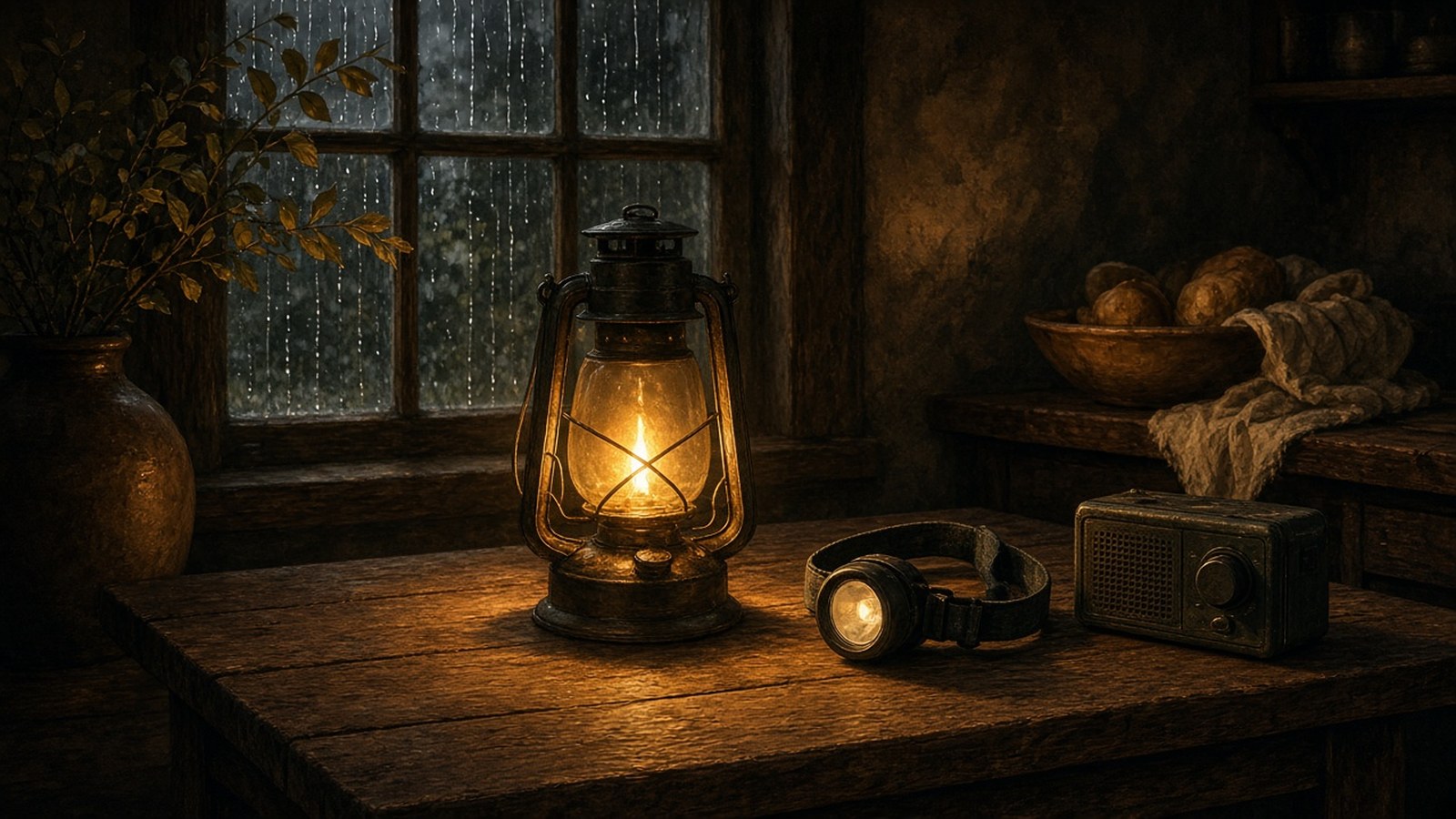
Featured Gear in This Guide
A short list for this chore. No prices, because those change. The button is a paid link.
-
Check on Amazon (paid link)
Jackery Explorer 1000 v2 Portable Power Station, LiFePO4
Jackery
Best for Quiet indoor backup power
-
Check on Amazon (paid link)
Jackery Solar Generator 1000 v2 with 200W Solar Panel
Jackery
Best for Station plus matched solar panel
-
Check on Amazon (paid link)
Black Diamond Apollo Rechargeable Lantern
Black Diamond
Best for Room and aisle lighting
-
Check on Amazon (paid link)
Black Diamond Spot 400-R Rechargeable Headlamp
Black Diamond
Best for Hands-free night chores
-
Check on Amazon (paid link)
Kaito KA500 Solar and Crank NOAA Weather Alert Radio
Kaito
Best for Storm alerts without power
When the power goes out in town, it is an inconvenience. When it goes out in the country, it can mean no well pump, no water heaters for stock tanks, no lights in the barn at feeding time, and sometimes days before the line crews get to the end of the road. Rural households need a different kind of outage plan: one that keeps a few critical things running, keeps everyone able to see, and keeps you informed about what the weather is doing next.
This guide focuses on quiet, indoor-safe backup power and lighting. It is not a replacement for a whole-house generator, but it covers the gap for most outages and a lot of everyday uses in between.
First, decide what actually needs power
Make a short list and be honest. For most rural homes it looks something like this:
- Phones and a radio so you can call for help and hear alerts.
- Lights in the house and the barn aisle.
- The refrigerator or chest freezer, run in cycles a few hours at a time.
- A CPAP or other medical device, if anyone in the household uses one.
- Small barn loads, like a heated bucket for a short stretch or a fan in a summer outage.
A well pump typically needs a larger generator or a whole-home backup system. Check your pump's rating with an electrician before counting on a portable unit for it.
Why LiFePO4 power stations make sense for rural homes
A portable power station is a big rechargeable battery with built-in outlets. Unlike a gas generator, it is silent, produces no fumes, and can be used safely indoors. Models built on LiFePO4 (lithium iron phosphate) chemistry are the ones to look for. They tolerate thousands of charge cycles, are more thermally stable than older lithium chemistries, and hold a charge well in storage, which matters for gear that might sit for months between storms.
Pair one with a solar panel and you can recharge it during daylight even when the grid is down for days.
The 5-piece outage kit
1. The core: Jackery Explorer 1000 v2 Power Station
The 1,000-watt-hour class is the sweet spot for most households: big enough to run a refrigerator for several hours, charge every phone in the house many times over, and keep lights and a fan going overnight, while still being light enough to carry from the house to the barn. This model uses LiFePO4 cells, recharges quickly from a wall outlet before a forecasted storm, and can act as a basic backup supply for sensitive electronics.
Why we like it: Quiet, indoor-safe, long-lasting battery chemistry, and a manageable size. Trade-offs: It is a significant investment. It will not run heavy loads like a well pump, electric range, or central air. Check the wattage of anything you plan to plug in.
Check current price on Amazon (paid link)
2. The recharge: Jackery Solar Generator 1000 v2 with 200W Solar Panel
A power station without a way to recharge is a countdown timer. A folding solar panel turns a multi-day outage into something you can manage, topping the battery back up during daylight. Standalone panels from many brands go in and out of stock, so the simplest route is often the bundle: the same Explorer 1000 v2 station packaged with a matched 200-watt folding panel, which means no guessing about connectors or adapters. If you already own the station, pick it up without the bundle and add a compatible panel later.
Why we like it: One purchase gets you storage and recharge that are designed to work together. Trade-offs: Real-world solar output depends heavily on sun angle, clouds, and heat. Expect a partial recharge on a cloudy winter day, not a full one, and plan your loads around that. The bundle is a bigger up-front investment than the station alone.
Check current price on Amazon (paid link)
3. The room light: Black Diamond Apollo Lantern
A lantern lights a whole kitchen table or barn aisle in a way a flashlight never will. The Apollo collapses for storage, stands on fold-out legs or hangs from a hook, dims to stretch runtime, and can run on its rechargeable battery or on standard batteries as a backup. Keep one in the house and one in the barn.
Why we like it: Warm, even light with a battery backup option, in a compact package. Trade-offs: It is not as bright as a big work light. For large barns, plan on two.
Check current price on Amazon (paid link)
4. The hands-free light: Black Diamond Spot 400-R Headlamp
Feeding, checking water, and dealing with a downed fence in the dark all need two hands. A rechargeable headlamp with a bright main beam, a dimmable setting, and a red night-vision mode is the most useful light you can own on a farm. Red light is also easier on the eyes of nervous horses at night.
Why we like it: Bright, rechargeable, waterproof, and it shows how much battery is left. Trade-offs: Recharge it after each use so it is ready for the next outage. Keep a basic spare on hand too.
Check current price on Amazon (paid link)
5. The information line: Kaito KA500 Solar and Crank Weather Radio
When cell towers are overloaded or down, a weather radio is how you hear tornado warnings, flood alerts, and updates about when power might return. This radio receives NOAA weather channels with an alert function, plus AM, FM, and shortwave, and it can be charged by solar, hand crank, or USB. It also has a flashlight and can give a phone a small emergency charge.
Why we like it: Multiple ways to power it, so it works even when everything else is dead. Trade-offs: Hand-crank charging is slow and tiring, and phone charging from the crank is truly an emergency-only trickle. Keep it charged from USB in normal times.
Check current price on Amazon (paid link)
Outage readiness routine
- Every month: Check that the power station is above about two-thirds charge and that lights and the radio are charged.
- Before a forecasted storm: Top off everything, fill water containers, and freeze jugs of water to keep the freezer cold longer.
- During an outage: Run the refrigerator in cycles, keep freezer doors closed, and use lanterns instead of overhead lighting.
- Never: Run a gas generator inside a house, barn, or attached garage. Carbon monoxide is a real and silent danger.
Common mistakes to avoid
- Buying a power station and never charging it. Batteries are only useful when they are full.
- Overloading. Add up the wattage of what you plug in. Heating appliances use far more than you think.
- Forgetting the barn. Put one lantern and one headlamp where the night chores happen.
The bottom line
A rural outage kit is about keeping the essentials going safely and quietly until the lights come back on. A LiFePO4 power station, a solar panel to recharge it, a good lantern, a reliable headlamp, and a weather radio will carry most households through the common outages that come with storm season, and they are just as useful on camping trips and at the far end of the pasture the rest of the year.
Related guides
Storm-Ready Water Storage and Off-Grid Basics for Rural Homes
When the well pump stops, water becomes the first problem. Plan ahead with a gravity filter, stackable water containers, a bathtub storage bladder, a manual drum pump, and a heavy-duty tarp.

The Everyday Cast Iron Starter Kit: 5 Heirloom Pieces Worth Keeping on Your Stove
A practical starter kit for cooking with cast iron every day: the skillet, the Dutch oven, and the three small tools that keep both seasoned, safe to handle, and neatly stored.

How to Set Up a Clutter-Free Farmhouse Coffee Bar That Works on Busy Mornings
Build a calm, functional coffee corner with a pour-over brewer, a conical burr grinder, a gooseneck kettle, airtight canisters, and a wood riser that keeps the counter tidy.